Mental Health and Disorders
Let’s discuss mental health and disorders in youth. What is going on and what can we do about it? I don’t have to tell you that mental health has declined in the last 10-15 years, but recognizing the pattern of change has some important consequences for the school board.
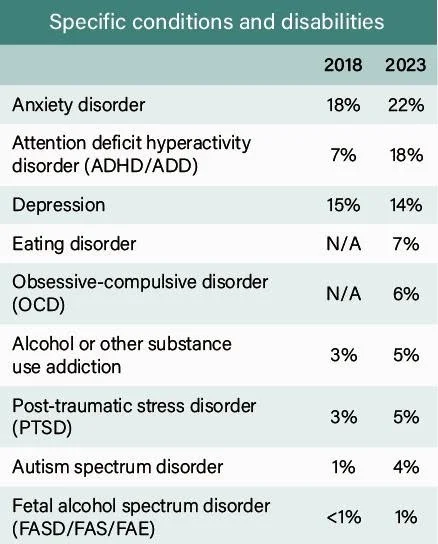
We have tons of survey data, and the patterns generally mirror clinical data. In the last 10 years, the biggest increases are in anxiety and ADHD/ADD. Recently, self-harm is increasing as well; although, the patterns are harder to discern as the definition has expanded. Females tend to be most affected. The peak of decline is around grade 9 and 10, at the tail end of puberty; there is some general improvement afterwards.
Why is it happening? Social media certainly has a corrosive influence, and I will have to post about this separately. Children with poor mental health also tend to lack meaningful relationships with adult figures. There are other corroborating factors like lack of sleep and poor physical health among others, but the important takeaway is that etiology is largely outside of the control of the school system. However, there are two main takeaways.
The increased prevalence of anxiety and ADHD should be alarming given our laissez-faire approach to education. The depreciation of learning standards and educational guidance most severely affects these students. Expecting these students to learn on their own with minimal guidance and standards is not only a recipe for disaster but also has a deleterious effect on their mental health as they fall behind their classmates year after year. They need more guidance; it is common sense. This is one of the main reasons why educational equality has deteriorated.
One can talk about a lot of mental health risk-factors, and we have discussed some of these already. However, there is one that might surprise you as being the strongest predictor. Poor school connectiveness consistently ranks as being among the best predictors of poor mental health. How connected students feel to their school, classmates and teachers is not just a feel-good aspect of education but instrumental for mental health. The school board certainly has a lot of influence in fostering a positive environment for all students, and the work must begin early in elementary school.
We can’t control what happens outside of schools, but school trustees need to be aware of the patterns of change in mental health and disorders. Explicit learning standards and guided education are needed now more now than ever while we strive for a school system that students feel connected to.
*The aggregate data mainly comes from three surveys: UBC's Human Early Learning Partnership, student learning surveys and the McCreary Centre Society (MCC) with MCC being the most comprehensive. Survey data has its own problems; people tend to overreport depending on how questions are asked and what is being asked. However, the pool of data is large, and they seem to agree more or less. My intuition is that the numbers are bad but not as bad as they seem. The trends are very concerning though.