Social Media
Let’s talk about social media and what we can do about it. I recently posted about mental health, and a lot of people were interested in what is causing the decline. Increasingly more people are pointing to social media use. This is an area where the school board has some discretion.
Let’s first recognize that social media use has changed a lot. I graduated in 2009 just as Facebook was becoming widespread. Back then, social media was far more about connections to people you knew and less prevalent. Fast-forward to today, the connections are increasingly not local; we have algorithms instead of people. As adults we can recognize that incessive use of social media is not healthy whether it concerns the perceptions of ourselves and the environment or its addictive qualities. For impressionable youth going through their formative years, the harm is far more palpable. Different levels of government are slowly recognizing the harms of social media. Most importantly, the federal government has introduced and tabled a tepid ban on youth social media use.
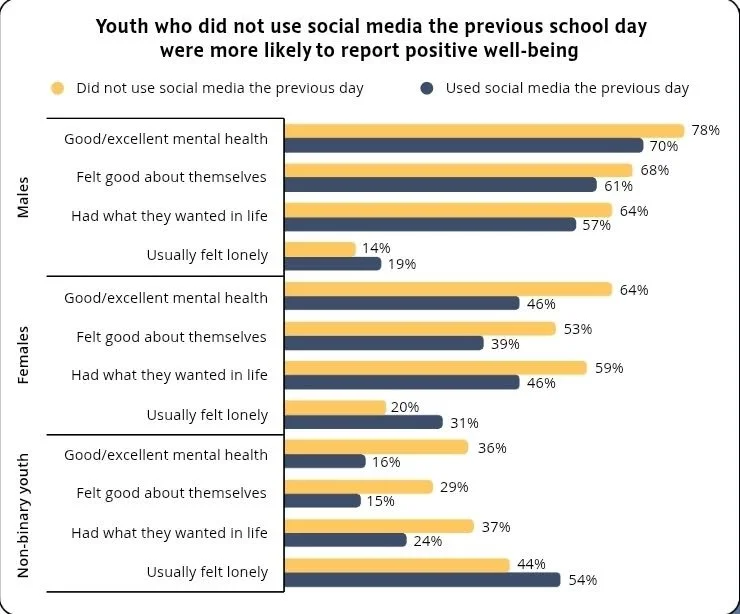
How prevalent and harmful is social media in SD73? We have some useful survey data. Mild use of social media tends to be harmless. Public Health Agency of Canada puts intensive social media use at ~30-40% for boys and ~40-55% for girls with higher grades showing more frequent use. Survey data from the Thompson Cariboo Shuswap area associates social media use to a myriad of poor mental health and educational outcomes especially when combined with lack of sleep. Females and nonbinary youth tend to be more affected. Other jurisdictions show very similar results. The correlation doesn’t come as a surprise for most people, but perhaps, the extent does. I also reckon that AI is about to make everything a lot worse.
What are we doing about it in BC and SD73? There is decent recognition that this is a problem. At the ministry level, there are a lot of education sources for parents, teachers and youth that teach about the harms of social media; although, most of these focused on cyberbullying. These are however optional, like many of our learning outcomes. The school board has colloquially useful resources for parents informing them about the social media harm, often labelled under “digital media literacy”. These are not bad, but again, they are optional.
As your school trustee, I fully support mandatory education on social media harm. As a one-time course for early youth, these can be relatively inexpensive and easily achievable with our discretionary spending. More importantly, they can make a meaningful difference for students in SD73.
*Intensive social media use is defined as “almost all the time throughout the day”
*There is a chicken and egg problem here obviously, the classical association and causation dilemma. Causation is essentially impossible to prove with social phenomena given its complexity and the inability to do RCTs. Cohort studies offer some illumination on causality but still have limitations. That being said, I believe social phenomena behave more through reciprocity than they do through directional causality. Finding strong and consistent association while controlling as best as possible is still very instructive. We have that for social media harm. It is a good place to start.