PISA Exams
What if I told you that we have lost at least 1-2 years’ worth of schooling in the last 10 years. Would that alarm you? Let me introduce you to PISA.
The PISA (Programme for International Student Assessment) is written by 15-year-olds across 90 participating countries every three years. Its basic categories of evaluation are math, science and reading. The students are chosen randomly, complete participation is encouraged and the results are standardized to a historical curve. It is a good, scientific attempt at measuring learning.
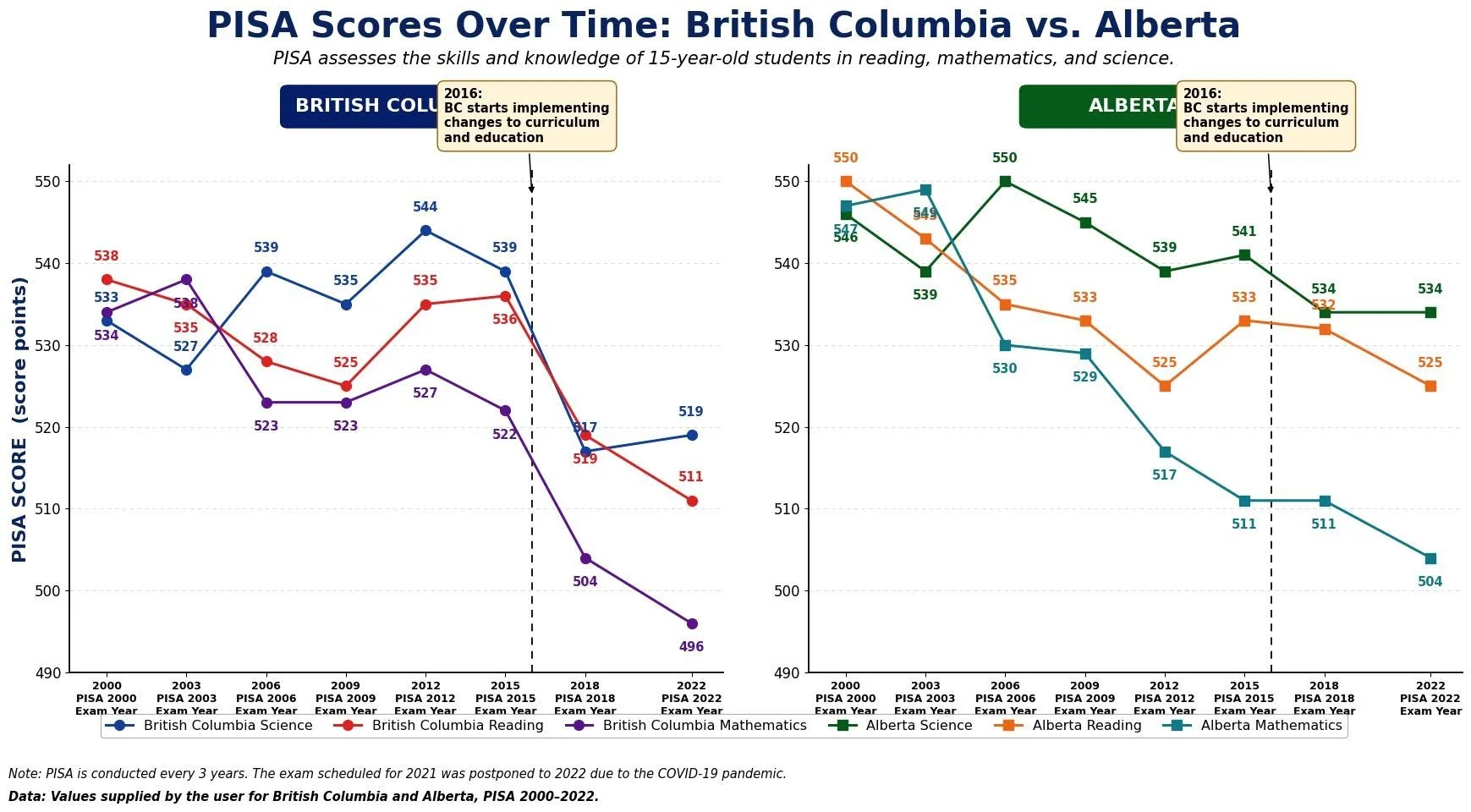
I believe exam results are a small component of a comprehensive education, but they are an objective analysis of trends; they provide us with a valuable snapshot. Unfortunately, the scores in BC have been dropping precipitously since 2015, and every 20-point drop represents approximately a year in education. Furthermore:
-There is significant decline among all students implying a wider, systemic cause. Every student in sd73 is affected. A cultural explanation is insufficient to explain the drop; not every parent stopped reading to their children before the start of kindergarten.
-Even as there is a decline among all students, those at the bottom that are more socially vulnerable are declining faster. Education inequality is increasing rapidly.
-Immigrants consistently score higher in a reversal of the trends in other developed countries. While being able to attract top-performing students should be a source of pride for Canadians, it should also serve as a warning for how our education system is performing.
-Once you control for immigrants, BC decline in PISA has been among the worst globally if it were its own country. Its decline is worse than any other province in Canada.
-Recent BC participation in the PISA exams has been quite low meaning our results are probably an overestimation.
-10-15 years ago, BC scored higher on PISA exams than Alberta. Today, BC scores significantly lower even though Alberta has had a decline as well. The main difference between Alberta and BC? BC started making some changes to its curriculum and approach to education in sharp contrast to Alberta.
Starting in 2016, BC started transitioning away from knowledge-based learning to competency-based learning. For many parents the most visible aspect of this change was that their children stopped receiving letter grades on their report cards, but the change was far wider encompassing than that. I will have to delve into what this curriculum exactly entails in another post. It will suffice to say here that we have moved away from standardization and clear, objective learning guidelines. Without standardization, standards suffer. Without standards, learning suffers; it is really simple as that. These changes are responsible for both decreased learning and increasing education inequality. As your school trustee I will oppose the new curriculum and ask to return to knowledge- based learning and standardization for the good of every student in sd73.
*You can do the same analysis with FSA exams. However, the FSA exams have changed a lot throughout the years, and participation is quite variable, so I don’t like using them for closer analysis. It should be said though that the FSA exams also show a decline.