Changes to Curriculum
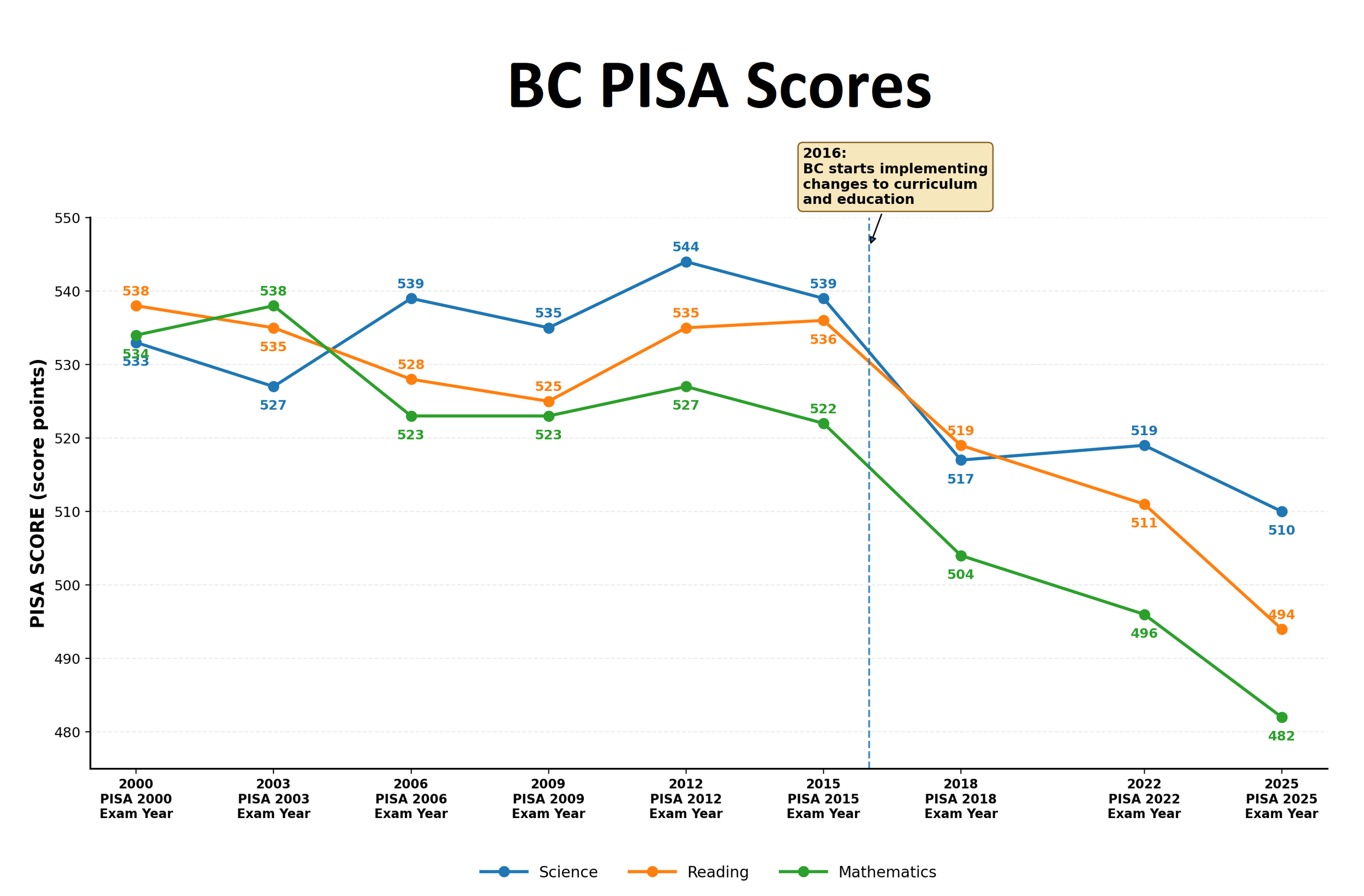
Starting in 2016, BC made some drastic changes to public education that largely went under the radar. What were these changes and what was the effect?
We transitioned away from knowledge-based education to competency-based education (CBE). The most generous description of CBE that I can give is that it is meant to focus more on thinking rather than simple regurgitation. The “know-do-understand” model is meant to be more individualized and show mastery of the subject rather than meet benchmarks. What does CBE mean in BC? The simple answer is that nobody knows, and that is part of the problem. If you have an extra thirty minutes, you can review the new BC curriculum online. If you leave with a more concrete understanding of what CBE entails, I would be surprised.
The research behind CBE is poor today, never mind ten years ago. It lacks peer-review, common definition and prescription. It uses unrepresentative samples and fails to demonstrate outcomes using systemized controls (Tahirsylaj & Sundberg, 2020 and Evans et al., 2021).
What has CBE meant in practice? I previously demonstrated in another post how since its implementation education quality has decreased while at the same time education inequality has increased. The most visible aspect of CBE for parents is that their children stopped receiving letter-grades on their report cards. While detrimental on its own, the report card changes were just a symptom. My main criticism of CBE is that it has eroded standardization and guidelines for learning. “Learning standards” lack the required precision and conciseness to give it any relevance. “Performance standards” are more precise, but according to the ministry, they “have been developed for voluntary use in B.C. schools”. What standards can be deciphered are also far too low; we are not meaningfully challenging students during their most formative years. This is not just my opinion. Lisa Beare herself recently said that “in the new curriculum there are fewer prescribed topics that all teachers must cover”. A survey conducted in 2019 by the BC Teacher’s Federation (BCTF) just as CBE was being fully implemented found that only 23% “have received clear guidelines related to student assessment”. Primordial subjects like math and English/French suffer the most as these subjects require longitudinal guidelines, K-12. For parents this frustration is most evident when they feel like their children are not being taught what is expected of them in their later school years. In truth, they haven’t been taught what should be expected of them for a while, and it becomes increasingly challenging for teachers to make up for lack of guidelines.
Not only has our version of CBE been terrible for education, but it has also been uniquely terrible for the challenges that education faces today. There are more distractions and obstacles to learning today than when I was a student. Social media, a drop in mental health and socio-economic changes have played a role. I will post about them separately as the school board needs to be proactive when it comes to these maligned influences. While it is true that there has been general decline in scores and outcomes globally in the West and country wide, nowhere in Canada has that decline been greater than in BC. With so many distractions and maligned influences, we need clear guidelines and explicit teaching now more than ever. The growing evidence from literature also agrees. The problem isn’t with CBE per say but that minimally guided education is horrendous for public education. For higher education, models akin to CBE, like problem-based learning, have been used extensively to some success. For motivated students with large knowledge-domains, CBE-like models can work as they do for medical students and anyone writing a thesis. For young, public-school children that lack adequate motivation in an environment wrought with distractions, CBE is the worst model on hand. This is why education inequality is increasing while quality itself is decreasing. It is the worst of both worlds for public education.
The experimental implementation of CBE translated into declining educational quality and deepening education inequality. As your school trustee, I will oppose CBE and encourage a return to standardization through hiring practices and oversight.
As always, please send me your questions and concerns.